
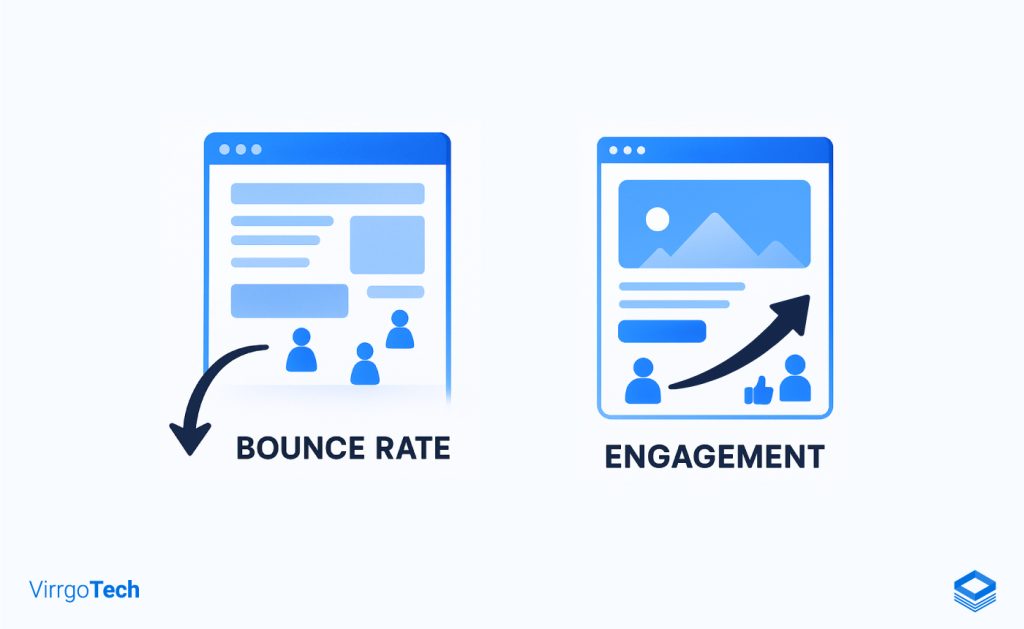
If you’re running PPC campaigns, you already know how much every click costs. You definitely don’t want visitors to land on your page, take one quick look, and vanish without doing a thing.
That behavior is what we call a bounce, and when it comes to PPC landing pages, bounce rate is one of the clearest signs that something isn’t clicking with your audience.
Plus, a high bounce rate significantly hurts your wallet. Every wasted click means wasted ad spend, and on top of that, platforms like Google Ads take note. If users consistently leave your page right away, your Quality Score drops, which can increase your cost per click and make it harder for your ads to compete. In short, high bounce rates drain both performance and budget.
Did you know that the average conversion rate for PPC landing pages hovers around 2–5%, and bounce rates can often hit 50–70% or higher if the page isn’t crafted well. That’s a lot of missed opportunities for leads, sales, or sign-ups.
However, with some smart and thoughtful tweaks, you can keep visitors on your page longer, guide them smoothly to your call-to-action, and turn more clicks into conversions. In this blog post, we’ll break down the best strategies and pay-per-click landing page optimization tips that actually work.
But before we dive into our main topic, let’s make sure we’re on the same page about what “bounce rate” actually means.
What is Bounce Rate in PPC Campaigns?
A bounce happens when someone clicks on your ad, lands on your page, and then leaves without clicking anything else. Just one lonely visit and poof, they’re gone. Bounce rate is simply the percentage of people who do that.
Now, why do people bounce? Usually, it comes down to a few common culprits:
Slow loading pages: People online are impatient. If your page takes more than a few seconds to load, most users won’t wait around.
Poor design or clunky UX: A page that looks outdated, cluttered, or hard to navigate is an instant trust-killer. If users can’t figure out what to do next, they’ll leave.
Irrelevant ad-to-landing-page messaging: Imagine clicking an ad for “50% off running shoes” and landing on a generic homepage with no sign of the offer. Frustrating, right? Misaligned messaging is a major bounce trigger.
Confusing CTAs: If your call-to-action isn’t clear, or worse, if there are too many competing CTAs, users won’t know where to click, and they’ll leave.
[Also Read: 4 Landing Page Optimization Tips to Improve Conversions]
So what’s “normal” when it comes to bounce rates?
Well, it depends on the industry, but generally:
- Retail/eCommerce PPC landing pages: 20–40%
- Lead generation pages: 30–50%
- B2B and SaaS landing pages: 25–55 and 40–60% respectively
- Content-heavy or blog pages linked from PPC ads: 40–60%
The key takeaway: if your PPC landing page bounce rate is going above 60–70%, it’s time to roll up your sleeves and make some changes.
The Role of Design in Reducing Bounce Rate
When it comes to bounce rate, design isn’t just about making a page “look nice.” It’s about shaping the visitor’s entire experience from the moment they land.
Think of your landing page as a store entrance: if the door is hard to open, the lights are flickering, and the signs don’t match what was advertised outside, most people will walk right back out. The same logic applies online.
Here’s why design matters so much:
- First impressions happen in seconds. Studies show visitors form an opinion about a website in just 3–5 seconds. If the design feels sloppy or confusing, they’ll leave before even reading your offer.
- Clarity builds trust. A clean, professional layout signals credibility. On the flip side, poor design can make even a legitimate business look sketchy.
- Good design guides attention. Visual hierarchy, smart use of white space, and clear CTAs lead the user exactly where you want them to go without distraction.
- Relevance keeps people engaged. If your ad promised one thing, your landing page design should instantly confirm it. That alignment between ad copy and page design reassures visitors they’re in the right place.
In short: design sets the tone, shapes perception, and determines whether someone explores further or heads straight for the exit.
[Also Read: How Website Design Affects User Experience: 5 Important Points]
Essential Tips to Reduce Bounce Rate
Now that we understand the “why,” let’s focus on the “how.” This is where pay-per-click landing page optimization comes into play. The goal is simple: make it effortless for visitors to stay, engage, and convert.
Below are some proven design and page optimization tips that can dramatically reduce PPC bounce rates.
Nail the Above-the-Fold Experience
The first screen visitors see should instantly confirm they’re in the right place.
- Use a headline that mirrors your ad promise (“50% Off Running Shoes” should lead to a landing page that says the same).
- Add a relevant, high-quality hero image or short explainer video.
- Place your CTA button at the front or in the center.
Master Visual Hierarchy & Layout
People scan before they read. A good layout helps guide the eye in a natural flow.
- Use an F-pattern or Z-pattern design so the page feels easy to skim.
- Rely on white space to avoid overwhelming the visitor.
- Use directional cues (arrows, contrasting colors, icons) that subtly point toward your CTA.
Keep Content Clear and Trustworthy
Craft a compelling ad copy so that your audience instantly feels a strong connection. Overloading with text or jargon is a surefire way to lose visitors. Instead:
- Break content into bite-sized chunks with bullet points.
- Reinforce credibility with trust signals, such as customer reviews, testimonials, security badges, or recognizable client logos.
- Make sure the language matches the ad: if the ad was playful, don’t land visitors on a page full of dry, corporate language.
Optimize Your CTA
Remember, your call-to-action is the moment of truth. If it’s weak or confusing, chances are that you’ve lost the lead. Here’s what you should do:
- Stick to one clear, primary CTA. Multiple CTAs only create decision fatigue.
- Use action-oriented text: “Start My Free Trial,” “Claim My Discount,” or “Book My Spot.”
- Make the button prominent with a contrasting color and sufficient size to be noticeable, but not overwhelming.
Speed & Performance First
Nobody enjoys waiting for a page to load. In fact, research shows that a 1-second delay can reduce conversions by up to 7%. For PPC traffic, that’s money slipping through the cracks.
- Compress images and use next-gen formats (like WebP).
- Leverage caching and CDNs for faster delivery.
- Test mobile speed separately.
Design for Mobile Responsiveness
With mobile traffic accounting for more than half of PPC clicks, your landing page needs to perform flawlessly on small screens.
- Ensure buttons are thumb-friendly and spaced properly.
- Avoid pop-ups or elements that block content.
- Test on different devices; what looks clean on a desktop may feel cramped on mobile.
When you consistently analyze PPC landing pages and apply these result-driven strategies, bounce rates will start to drop, and conversions will climb.
[Also Read: Conversion Rate Optimization: Best Practices To Improve Your Conversion Rate]
Exploring Advanced Strategies to Reduce PPC Bounce Rates
Once you’ve nailed the basics, it’s time to take your pay-per-click landing page optimization to the next level. These advanced tips go beyond surface-level tweaks, helping you reduce PPC bounce rates even further.
Add Interactive Elements
Engagement increases dramatically when visitors are encouraged to interact with the page rather than passively consume information. Adding elements like quizzes, calculators, or product selectors keeps users invested and curious about the outcome.
Even simple design touches, such as progress bars on multi-step forms or subtle hover animations, create micro-interactions that make the page feel alive. These small enhancements not only keep attention but also guide visitors toward the call-to-action in a more natural way.
Personalization & Dynamic Content
Generic, one-size-fits-all landing pages rarely perform well because they fail to connect with the visitor’s intent. By personalizing your landing page, you make it feel tailored to the individual.
One effective method is dynamic text replacement, which allows your headline to automatically mirror the exact keyword or ad copy that drove the click. You can also personalize based on geography, device, or audience segment to keep the content highly relevant.
Keep Forms Simple and Friction-Free
Forms are often where conversions either happen or fall apart. Asking for too much information is one of the fastest ways to drive users away. The most effective approach is to keep forms short, requesting only what you truly need at the initial stage.
Autofill features make the process even smoother, and reassuring visitors with privacy or security badges helps build trust. A friction-free form experience ensures that all the effort spent getting someone to the landing page doesn’t go to waste at the final step.
Leverage Behavioral Triggers
Behavioral triggers are subtle cues that encourage action at the right time. Exit-intent popups, for example, can capture abandoning visitors with a last-minute incentive, while sticky CTAs ensure that the conversion button is always within reach as users scroll.
Adding live chat widgets or AI assistants can also reduce hesitation by answering common questions immediately. These small interventions can turn hesitation into commitment, reducing the number of lost visitors.
Run Ongoing A/B Testing
No matter how polished a landing page looks, there’s always room for improvement, and A/B testing is the best way to identify it. By consistently analyzing PPC landing pages through structured experiments, you can identify which design and copy variations perform best.
You might discover that one headline grabs attention far better than another, or that a different CTA color leads to more clicks. Over time, these incremental improvements compound into significant gains, allowing you to refine your landing page for maximum performance.
These advanced tips transform a landing page from a static advertisement into an interactive, conversion-focused experience. By personalizing content, encouraging engagement, and using behavioral psychology, you not only reduce PPC bounce rates but also maximize the value of every single click.
Measuring Success After These Changes
Making these changes to your PPC landing pages is only half the battle; the real value comes from tracking whether those changes actually move the needle.
Without proper measurement, you’re essentially flying blind. That’s why it’s critical to analyze PPC landing pages and existing PPC trends for maximum results.
Tools for Tracking: Analytics platforms are your best friends here. Google Analytics gives you the raw data on metrics like bounce rate, session duration, and conversions, while tools like Hotjar or Microsoft Clarity provide visual insights. With heatmaps and scroll maps, you can literally see where users are clicking, how far they’re scrolling, and where their attention starts to fade.
Key Metrics to Watch: When evaluating whether your pay-per-click landing page optimization efforts are working, focus on a few critical KPIs. Bounce rate is the obvious one, but don’t stop there. Track dwell time, scroll depth, and conversion rates. Looking at these together gives you a holistic view of overall performance.
The Power of Iteration: Remember, improvement doesn’t happen in one shot. Even the best-designed landing pages need constant testing and optimization. Run A/B tests on headlines, CTAs, or layout tweaks, then measure the impact. If something doesn’t work, adjust and try again.
By measuring success thoughtfully and treating design as an ongoing process, you’ll ensure that every change you make is grounded in data. That’s how you maximize the impact of your PPC campaigns and get the most out of every click.
Final Words
A well-crafted landing page doesn’t just look good; it lowers bounce rates and boosts conversions. Every element, from the headline to the CTA button, plays a role in guiding visitors toward action and ensuring your PPC dollars don’t go to waste.
Now’s the time to take a critical look at your own campaigns. Audit your current PPC landing pages, analyze what’s working and what isn’t, and improve accordingly.
Remember, always work smarter, and you’ll turn more of those costly clicks into paying customers.
[Also Read: 6 Modern Website Design Trends To Follow in 2025]